
The U. S. Exploring Expedition in Antarctica
POSTED ON: Friday, January 31, 2020 12:00 AM by Jennifer Bryan
On January 19, 1840, Lieutenant Charles Wilkes, USN, commander of the United States South Seas Exploring Expedition, claimed for his country the discovery of Antarctica after sighting land from the sloop-of-war USS Vincennes, the flagship of the expedition. The existence of the southern continent had yet to be conclusively proven, and the Exploring Expedition was America's entry in the international race to be first to discover and explore the icy realm. Wilkes would later write in the published account of the expedition that "the following narrative must, I feel satisfied, leave no doubt in any unprejudiced mind of the correctness of the assertion that we have discovered a vast continent."
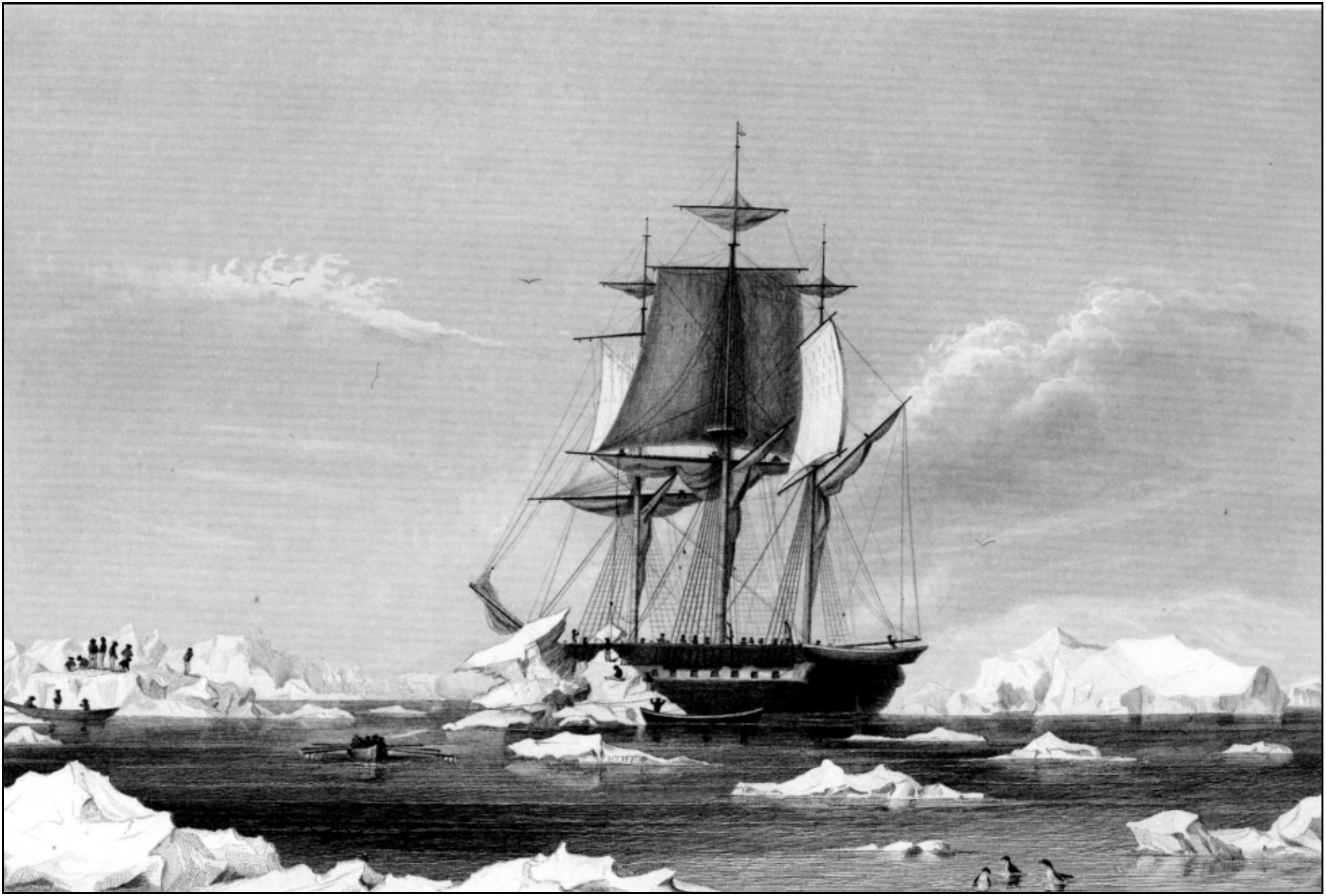
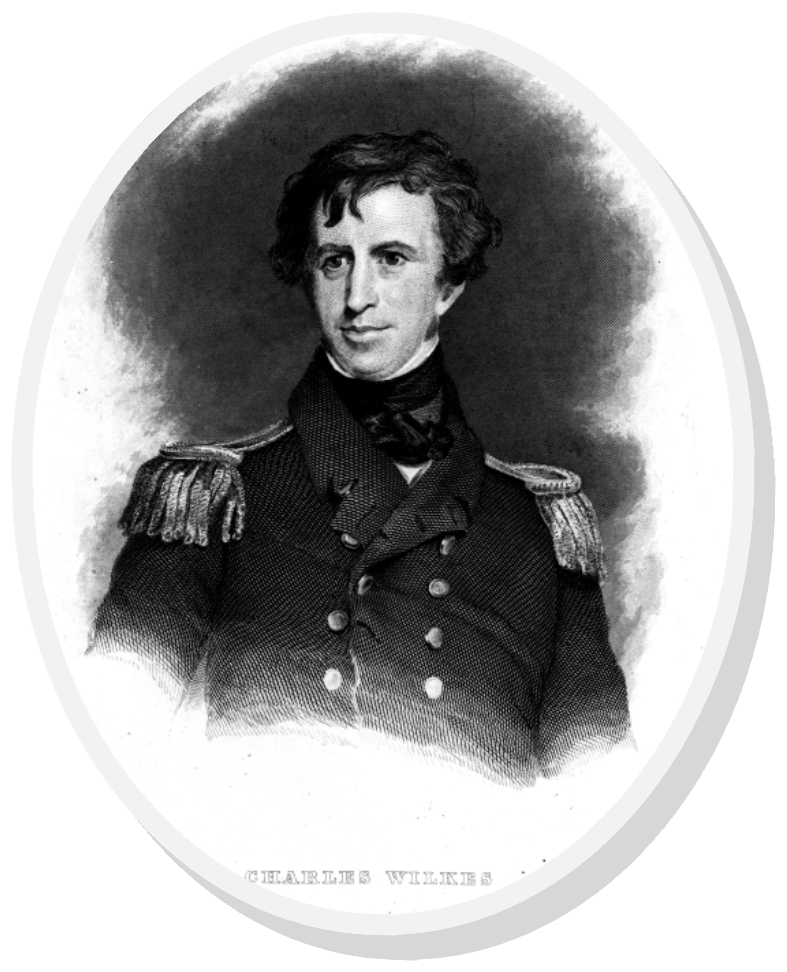
Congress had authorized the United States South Seas Exploring Expedition, the first U.S. government-sponsored voyage of exploration and discovery, in May 1836. Between 1838 and 1842, the Exploring Expedition, consisting of six vessels and 346 men, including nine scientists and artists, surveyed 280 Pacific islands, charted 800 miles of the Oregon coast, explored 1,500 miles of the Antarctic coast, and amassed meteorological, astronomical, magnetical, and hydrographical data. In addition, the expedition collected thousands of ethnographic and natural history specimens, the disposition of which shaped the development of the Smithsonian Institution.
The impetus for the Exploring Expedition (U.S. Ex. Ex. or Ex. Ex. for short) was the protection and extension of commerce. The Committee on Naval Affairs reported to the Senate: "No part of the commerce of this country is more important than that which is carried on in the Pacific Ocean. It is large in amount....Its results are profitable....It is a nursery for seamen for which no substitute can be found....[it] may be greatly extended in all its departments....and the theatre of its enlargement is most ample; but it requires aid and encouragement. No part of our commerce is so much exposed to hazard and peril. That portion of the globe is less known, and the ocean more filled with dangers than any other that our seamen visit. There are hundreds of islands, reefs and shoals, unmarked upon any chart, and unknown to common navigators. Their location, situation, facilities for commerce, are yet to be explored and exhibited to the world." Yet another motive besides commercial considerations influenced the committee's recommendation to authorize the expedition: "the extension of useful knowledge of the globe which we inhabit."
While commerce was the impetus for the U.S. Ex. Ex., Congress also had in mind the advancement of science. Jeremiah N. Reynolds, who had been advocating for a government-sponsored expedition to the South Seas for ten years, gave an impassioned speech to Congress in which he touted the contributions to scientific knowledge that the young United States could make through a voyage of exploration and discovery. He declaimed, “without some devotion to science and liberal pursuits, though we may become powerful, yea, in an uninterrupted career of prosperity, invincible by land and sea, yet we can never be truly great!” As one newspaper editorialist noted, England, France, and other European countries had promoted voyages of discovery that “led to results highly advantageous to the interests of commerce, as well as eminently conducive to the advancement of science.” Thus, the U.S. Ex. Ex. would serve the interests of science as well as commerce in its nearly four-year circumnavigation of the globe.
The U.S. Ex. Ex. would be America’s entry in the race to be first to reach farthest south. In September 1837, the French government had sent two corvettes under the command of Jules Dumont d’Urville from Toulon with a goal of reaching the South Pole, or as far south as possible. The British, having found the north magnetic pole, were eager to claim the south magnetic pole and sent two vessels under the command of James Clark Ross in quest of this prize in September 1839. Reynolds, in his speech to Congress, had exclaimed in a rhetorical flourish, “What! extend our researches to regions surrounding the South Pole! And wherefore not? Shall the reproach for ever rest upon our character, that we can do nothing, think of nothing, talk of nothing, that is not connected with dollars and cents?...Will you not allow us some scope for high and daring adventure?
On December 26,1839, sailing south from Sydney, Australia, Vincennes, in company with the sloop-of-war USS Peacock and the gun-brig USS Porpoise, carefully probed the icy seas. Wilkes' first foray into this frozen realm, made from Tierra del Fuego, had occurred on February 25, 1839, but bad weather and the lateness of the season had forced him to turn back after ten days. The expedition hoped to meet with more success on its second cruise into Antarctic waters.
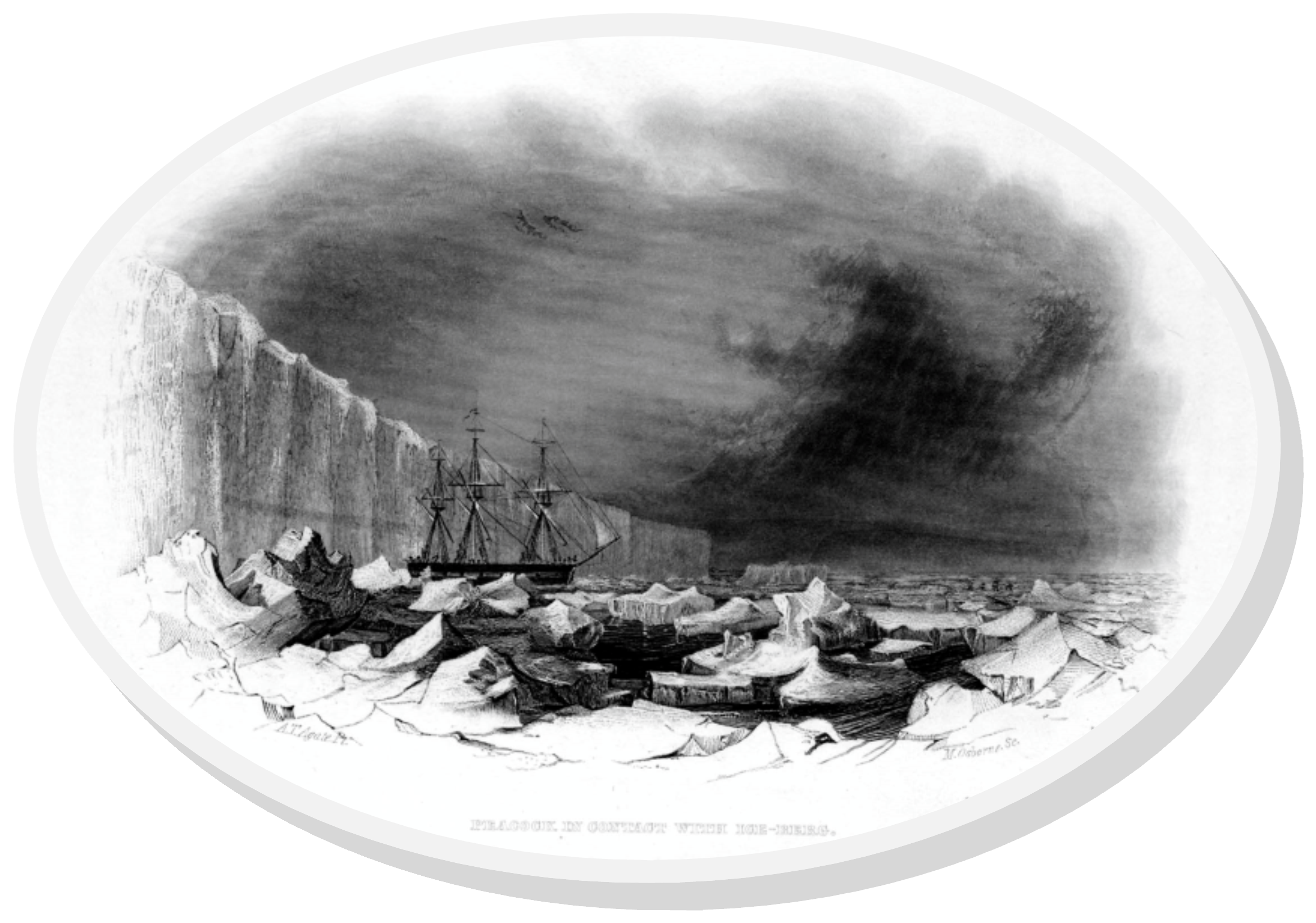

On January 23, 1840, Peacock's rudder was damaged in a collision with the ice and it drifted stern first into an iceberg. The ship survived this ordeal and limped back to Sydney only to be lost a year later off the mouth of the Columbia River. Vincennes and Porpoise reached the pack ice, what Wilkes described as the "icy barrier," and explored westward along its edge. The two ships lost contact with one another on the afternoon of January 27. The illustration at right depicts Porpoise weathering a gale the night of February 2. The previous day, Porpoise had sighted the French exploring vessels Astrolabe and La Zélée under the command of Dumont-d’Urville. According to the official narrative of the U.S. Ex. Ex., Porpoise attempted to come within hailing distance of the French flagship, but “so far from any reciprocity being evinced, I [Cadwalader Ringgold, commander of the Porpoise] saw with surprise sail making by boarding the main tack on board the flag-ship….it cannot but excite the surprise of all that such a cold repulse should have come from a French commander, when the officers of that nation are usually so distinguished for their politeness and attention.” Porpoise headed for New Zealand on February 14.
Having first sighted land on January 19, Wilkes aboard Vincennes continued his exploration along the "icy barrier." On January 30, he recorded, "now that all were convinced of its existence, I gave the land the name of the Antarctic Continent." On January 31, he wrote, "feeling satisfied that a great extent of land wholly unknown lay to the westward, I deemed it my duty to proceed to its discovery." Ice repeatedly thwarted Wilkes's attempts to make landfall on the continent, but on February 14 he landed on an "ice-island." Wilkes wrote in his official narrative of the expedition, “In the centre of this iceberg was found a pond of most delicious water….We obtained from it about five hundred gallons. We remained upon this iceberg several hours, and the men amused themselves to their heart’s content in sliding....There was no doubt that it had been detached from the land, which was about eight miles distant. The view of the land, ice, &c., taken from this ice-island...gives a correct representation of these desolate regions.” By February 21, Wilkes decided that he had spent long enough exploring the southern ocean and it was time to head north.

The U.S. Ex. Ex. would continue its voyage of exploration and discovery for another two years, returning to the United States in June, 1842. Although Russian naval officer Fabian von Bellingshausen was probably first to sight the Antarctic Continent in January 1820 and sealer John Davis was likely the first to land on its shore in 1821, Wilkes was the first to prove the extent of Antarctica by mapping 1,500 miles of the continent's coastline. Wilkes Land, the name nineteenth-century German cartographers gave to a portion of East Antarctica and by which the region is still known, commemorates the achievement of the United States South Seas Exploring Expedition and its commander.
Sources:
Army and Navy Chronicle, November 1836, 284.
Gurney, Alan. The Race to the White Continent. New York and London: W.W. Norton & Company, 2000. Call number: G 860.G84 2000
Philbrick, Nathaniel. Sea of Glory: America's Voyage of Discovery, the U.S. Exploring Expedition, 1838-1842. New York: Viking, 2003. Call number: GN 663.P48 2003
Reynolds, J. N. Pacific and Indian Oceans: or, the South Sea Surveying and Exploring Expedition: Its Inception, Progress, and Objects. New York: Harper & Brothers, 1841. Call number: Q 115.W773 1841
Viola, Herman J. and Carolyn Margolis, eds. Magnificent Voyagers: The U.S. Exploring Expedition, 1838-1842. Washington: Smithsonian Institution Press, 1985. Call number: G 420.U55 M34 1985
Wilkes, Charles. Narrative of the United States Exploring Expedition. 5 vols. Philadelphia: C. Sherman, 1844. Call number: Q 115.U46 1844 (all illustrations in this post from volumes 1 and 2)
Category: Ocean and Atmospheric Sciences, Naval & Military Studies, Seamanship & Navigation, History