
The Hungarian George Washington visits Annapolis
POSTED ON: Thursday, March 18, 2021 12:00 AM by Jennifer Bryan
On January 13, 1852, U.S. Naval Academy Superintendent Cornelius K. Stribling ordered noon recitations canceled "to enable the Students to visit Louis Kossuth." Today's midshipmen most likely never have heard the name Kossuth, nor recognize why he would warrant an alteration to the academy's routine. In the winter of 1851-1852, however, Kossuth-mania swept America.
 |
| Louis Kossuth (1802-1894) from Hungary and Its Revolutions (London, 1854) |
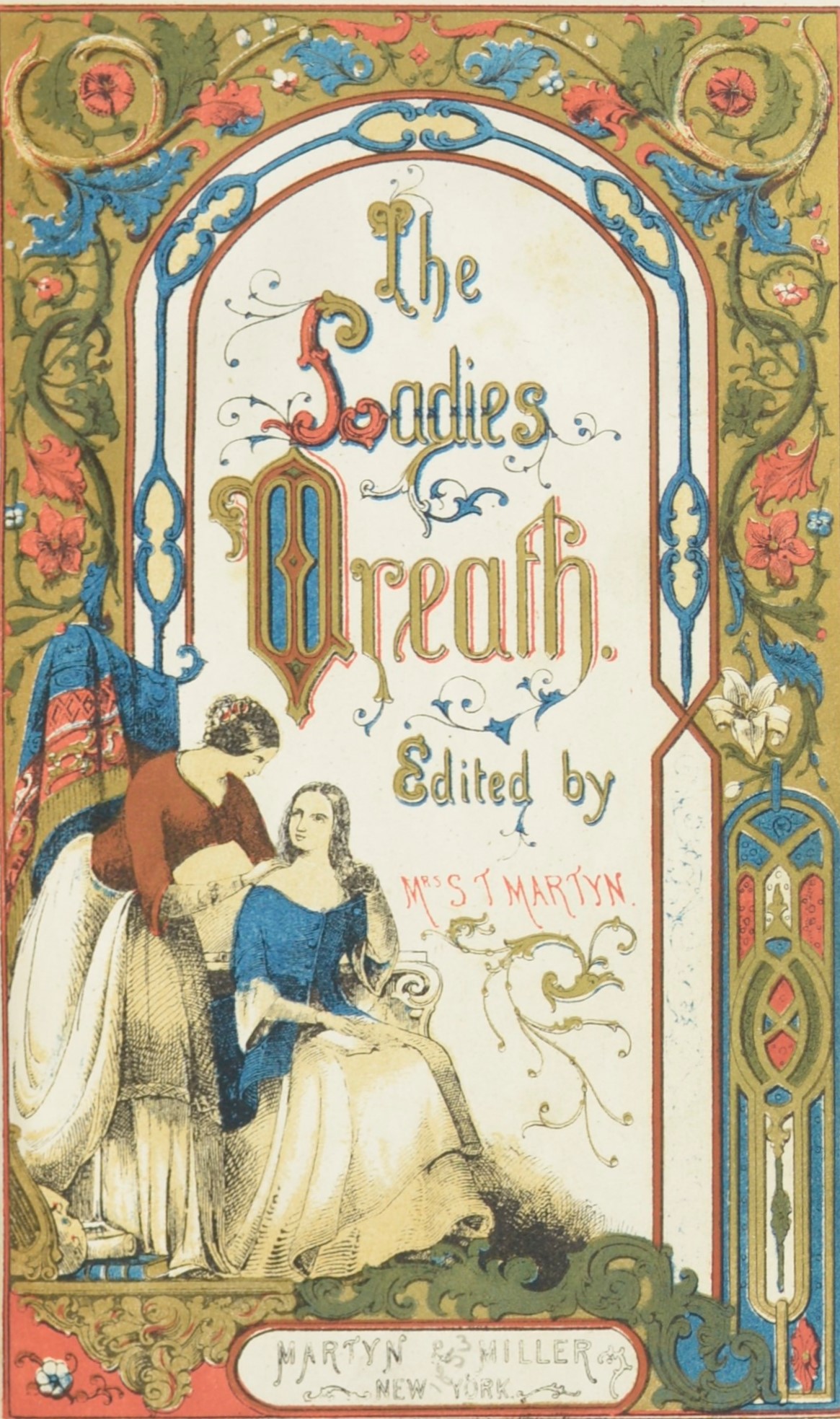  |
| George S. Burleigh's poem "Kossuth," originally published in the Ladies' Wreath for June 1850 and subsequently in an annual volume published in 1852. |
Lajos, or Louis, Kossuth was the great champion of Hungarian independence from Austria. The kingdom of the Magyars had been an elective monarchy for almost 700 years until the Austrian Habsburgs established themselves as hereditary monarchs in 1687. By 1815, the "Empire of Austria" consisted of Austria, Hungary, Bohemia, Moravia, Silesia, Galicia, Lodomeria, Tyrol, Styria, Carniola, Carinthia, Dalmatia, Croatia, Slavonia, Lombardy, Venice, Trieste, and Transylvania. The emperor, from his capital in Vienna, held this patchwork of provinces and peoples together through his exercise of absolute power. In the aftermath of the Napoleonic Wars, a movement to reform the Austrian government came into being with Kossuth among its leaders. He soon dominated the liberal party in Hungary with his impassioned and powerful oratory.
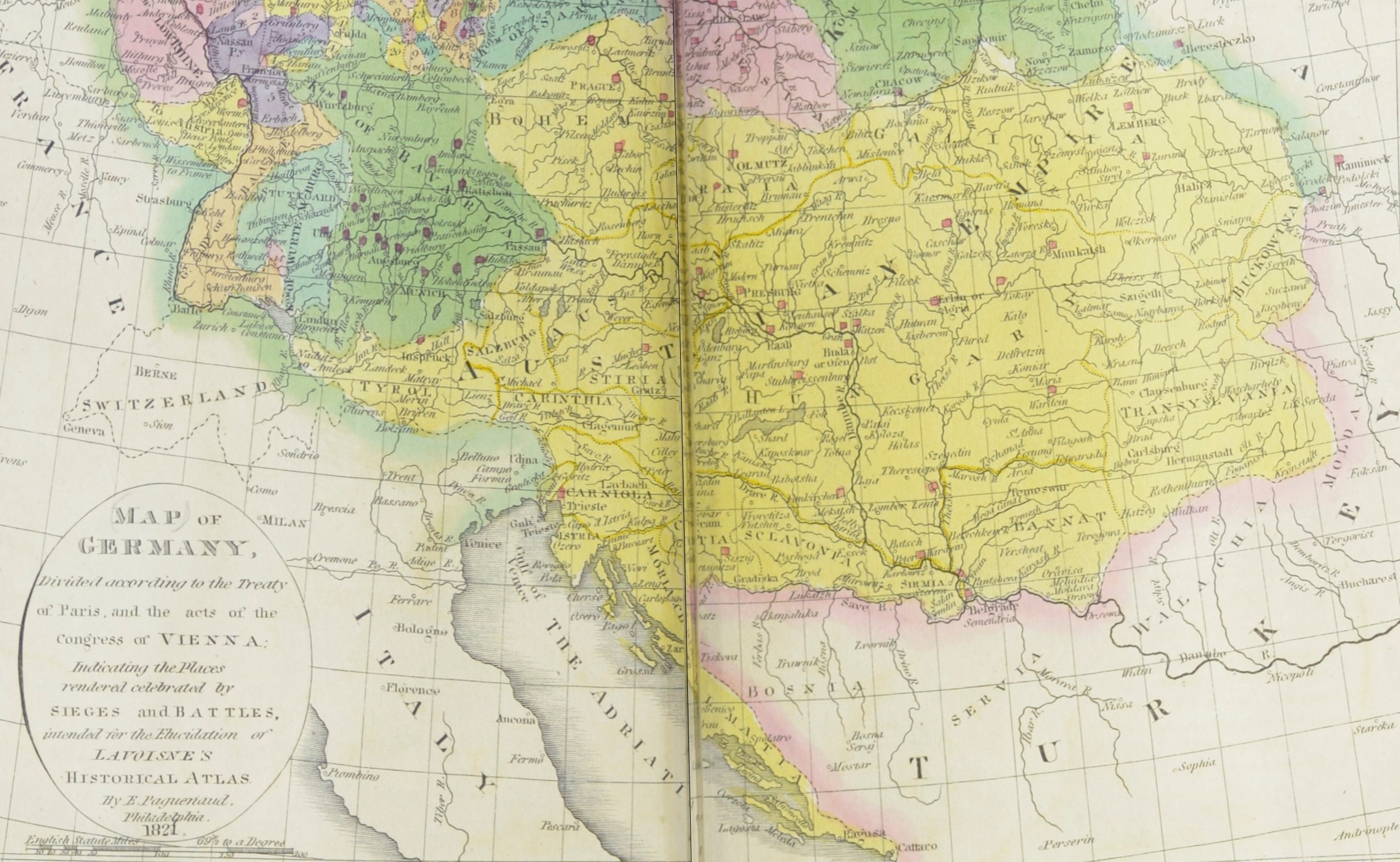 |
| Map of Germany showing the Austrian Empire (Lombardy and Venice appear on the map of Italy) from C.V. Lavoisne, A Complete Genealogical, Historical, Chronological, and Geographical Atlas (Philadelphia, 1821). |
When revolution spread across Europe in 1848, Kossuth demanded constitutional government for Austria with an independent constitution for Hungary. Addressing the Hungarian diet (parliament) on March 3, 1848, Kossuth declaimed,
Yes, honourable members, it is my conviction that the future existence of the Dynasty is bound up with the brotherhood of the different peoples belonging to the empire, and this brotherhood between nationalities can only be cemented by constitutional forms of government which will awaken the feeling of one family. The bureau and the bayonet is a wretched medium by which to unite the parts of the empire. In the motion which I bring forward I have the interests of the Dynasty at heart.
In the wake of revolt in Vienna on March 13, and the subsequent collapse of the imperial government, Emperor Ferdinand acceded to his subjects' demands. Kossuth became minister of finance in the new Hungarian government. His extreme nationalism, however, antagonized the Slavic peoples of Hungary, who allied themselves with conservative elements within the empire to oppose the Magyars. "It was the great error of the Hungarians, and the rock upon which their bark of state was wrecked," wrote William Stiles in his history of Austria during the revolution of 1848, "that, while they were struggling with the imperial government for the establishment of their own nationality, they were reluctant altogether to respect the nationality of those provinces which lay within their borders." In July, in a rousing speech in the Hungarian diet, Kossuth called upon the nation to arm in self-defense. By late autumn, a new imperial government had formed and on December 2, Ferdinand abdicated in favor of his eighteen-year-old nephew Francis Joseph. All the concessions of March were revoked, Kossuth and his colleagues were outlawed, and soon an Austrian army was marching against the Hungarian capital. The Hungarian diet formally refused to acknowledge the new king and called the nation to arms. From this time, Kossuth assumed full control of the government.
  |
|
Portrait of Kossuth and title page from William Stiles' Austria in 1848-49 (New York, 1852). |
In April 1849, the Hungarian diet declared independence from Austria and appointed Kossuth governor of the new republic. The victories during the winter of General Artúr Görgei’s Hungarian forces over the imperial army had led to this step. The declaration of independence, however, stating "that the House of Hapsburg-Lorraine, as perjured in the sight of God and man, has forfeited its right to the Hungarian throne," alienated those who wished merely for autonomy under the old dynasty, adding further turmoil to the country's perilous state of affairs.
 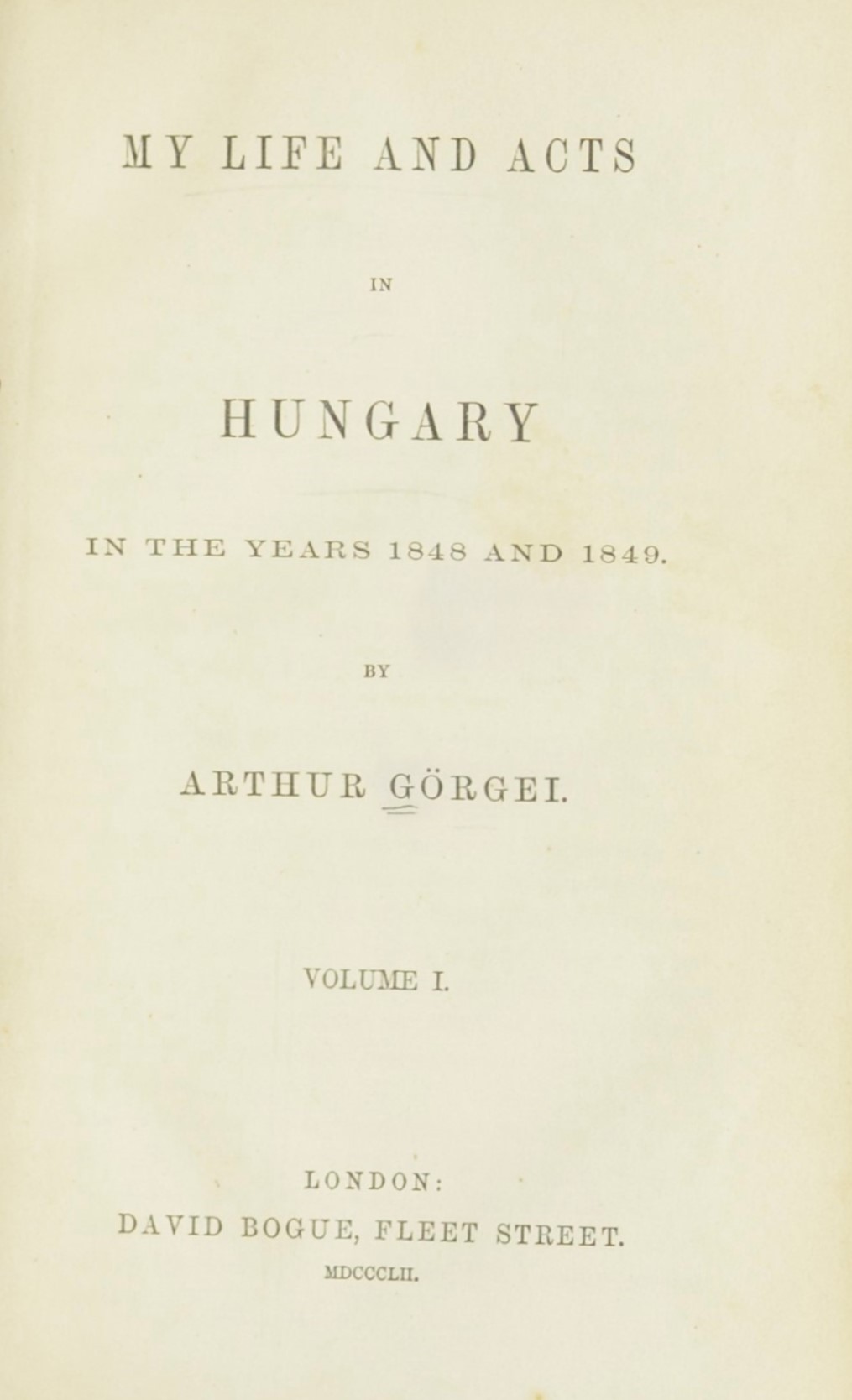 |
| Half-title and title page of Artúr Görgei’s memoirs, a gift to the Naval Academy from John Howard March (1791-1863), US Consul at Madeira from 1817 to 1859. Samuel Marcy (1820-1862) was a founding member of the faculty. |
The Hungarian republic survived a mere four months. When Vienna accepted the aid of Tsar Nicholas I, who sent a Russian army across the Carpathians, the fate of the infant nation was sealed. On August 9, imperial troops routed the Hungarians at Temesvar and on August 11, Kossuth abdicated. "[W]hen, as he thought, no hope remained of serving the cause of expiring Hungary, [Kossuth] escaped into Turkey, and delivered himself up to the Ottoman garrison at Widdin." The Austrian and Russian ambassadors at Constantinople demanded that the refugees be turned over to them. The Ottoman government found itself in an awkward position, for it did not want war with the powers on its borders yet the Hungarians had trusted themselves to the Turks. Rather than turn the Hungarians over to the Austrians, the Turks held Kossuth and his fellow exiles as political prisoners.
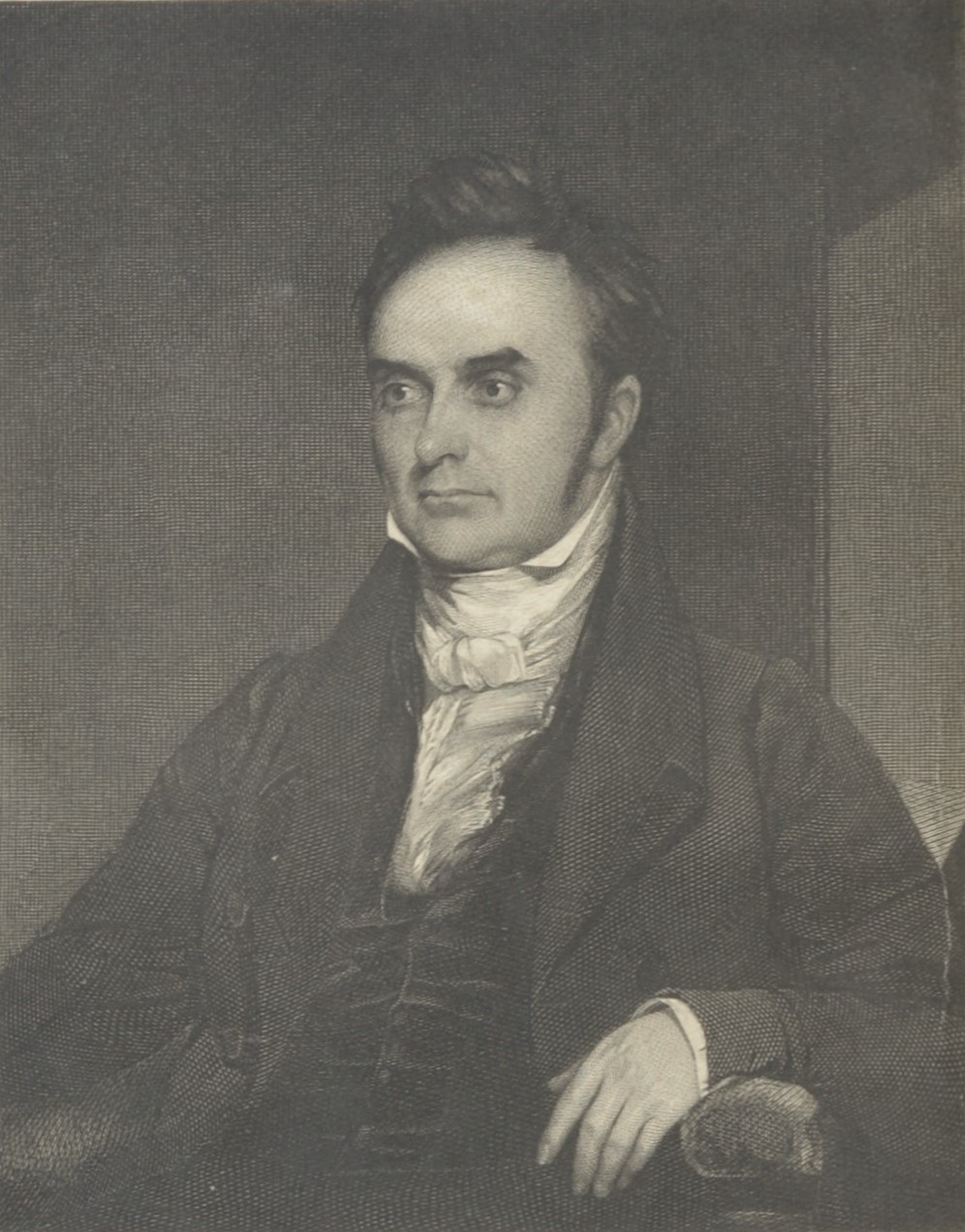 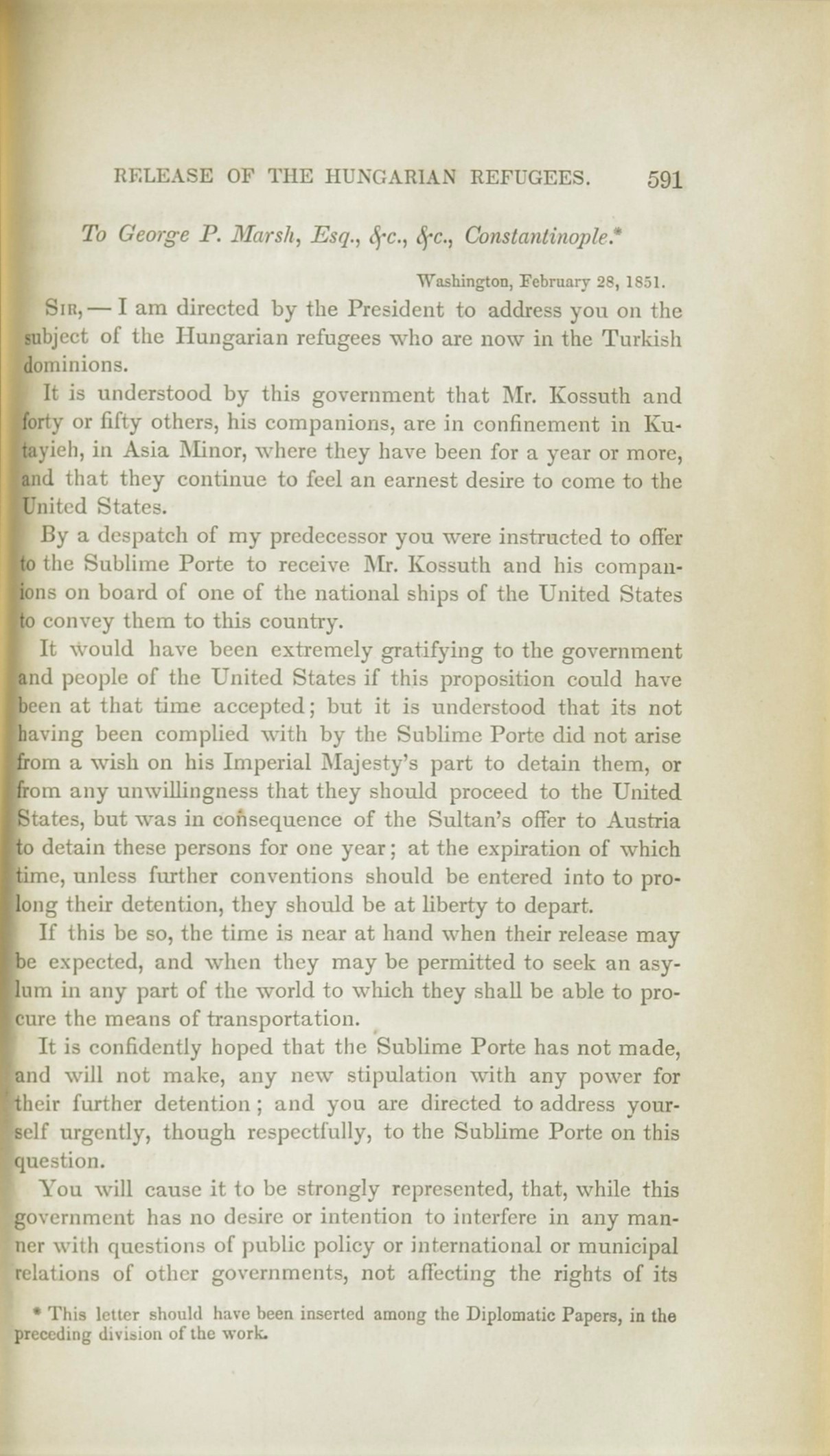 |
| Daniel Webster, as Secretary of State under President Millard Fillmore, instructed George P. Marsh (1801-1882), US minister-resident to the Ottoman Empire, to convey to the Ottoman government the willingness of the US to take Kossuth and his fellow exiles from Turkey. |
In 1850, the US government offered asylum to Kossuth and his companions. The USS Mississippi arrived at the Dardanelles in September 1851 and took on board 60 persons. America's minister-resident at Constantinople warned Captain John C. Long, commander of the Mississippi, that the ship should "touch as few ports as possible, and remain as short a period at them, as is possible" to prevent Kossuth from attempting to restart his failed revolution at the cost of American neutrality. Kossuth took umbrage at the restrictions placed upon him and when the Mississippi arrived at Gibraltar, Kossuth departed for England where he "toured triumphantly" for three weeks before booking passage to America on the Humboldt.
Kossuth visited the US, delivering speeches on behalf of Hungarian independence, in hopes of obtaining economic and military support to rekindle his cause. In New York City, his first stop, he was greeted with wild enthusiasm. Portraits of Washington and Kossuth hung outside the windows of Irving House, where he was staying. He was often referred to as the "Washington of Hungarian liberty." A contributor to the North American Review commented, "Kossuth has been compared to Washington, by some people more enthusiastic than wise. It would be impossible to imagine a more infelicitous comparison; scarcely a single point of resemblance between the characters and career of the two men can be alleged to justify it."
On January 12, 1852, Kossuth and his entourage arrived in Annapolis. Maryland Secretary of State Thomas H. O'Neal met the group at the train station and escorted them to the governor's mansion. At 2 p.m., a delegation from the Maryland legislature waited upon Kossuth and invited him to visit the state house the following day. Later in the afternoon, Governor Enoch Louis Lowe hosted a dinner for Kossuth at the mansion, followed by a levee. Lieutenant J. Van Ness Philip, who had been an officer aboard the Mississippi, was now attached to the Naval Academy and invited Kossuth and his party to visit the school. The visitors saw the lyceum, where "stuffed birds, shells, a geological collection, models of ships, some few Egyptian, Roman, and Greek antiquities, some medals and curiosities from the South Sea, fill a large room, whose principal decorations are some relics of the naval heroes of America: Paul Jones, Commodore Decatur, and [Oliver Hazard] Perry."
  |
| According to Francis Newman's introduction to his compilation of Kossuth's speeches, the Hungarian's "orations are a tropical forest, full of strength and majesty, tangled in luxuriance, a wilderness of self-repetition. Utterly unsuited to form a book without immense abridgment, they contain materials adapted equally for immediate political service and for permanence as a work of wisdom and genius." |
On the afternoon of January 13, Kossuth addressed the Maryland legislature, both houses of which had invited him to speak. It is likely that at least a few midshipmen were present as the officer-of-the-watch log indicates that they had permission to hear his remarks. Standing in the senate chamber, the same room in which Washington had resigned his commission as commander in chief of the Continental Army in December 1783, Kossuth pointed to the portraits of Thomas Stone, Samuel Chase, Charles Carroll of Carrollton, and William Paca, "the glorious architects of the independence of this republic, grown up to such a giant in such a short time....all of them signers of the Declaration of American Independence, that noblest, that happiest page in mankind's history." His peroration ended,
Sirs, I stand, perhaps, upon the very spot where your Washington stood, consummating the greatest act of his life. The walls which now listen to my humble words, listened to the words of his republican virtue, immortal by their very modesty. Let me, upon this sacred spot, express my confident belief that if he stood here now, he would tell you that his prophecy is fulfilled; that you are mighty enough "to defy any power on earth in a just cause," and he would tell you that there never was and never will be a cause more just than the cause of Hungary, being, as it is, the cause of oppressed humanity.
Despite rousing speeches and public enthusiasm, Kossuth's attempt to raise support in the US for a revival of the Hungarian Republic failed. He traveled throughout the country, giving by one estimate more than 500 speeches "great and small."
The Naval Academy's interest in Kossuth is evidenced by a number of books about Hungary, its revolution, and its Washington that the school added to its library in the 1850s. For a general description of the country, midshipmen could peruse John Paget's Hungary and Transylvania; with Remarks on Their Condition Social, Political, and Economical or Julia Pardoe's The City of the Magyar, or, Hungary and Her Institutions in 1839-40. For an account of Hungary after the revolution, the midshipmen might read Charles Loring Brace's Hungary in 1851; with an Experience of the Austrian Police. Brace noted that "even now, with Austrian soldiers in every village, without arms or means, despoiled of its best and bravest, the land needs but his [Kossuth's] voice to start it again into a whirlwind of revolution." Such potential for reigniting rebellion explains why Captain Long of the Mississippi had been encouraged to visit as few ports as possible.
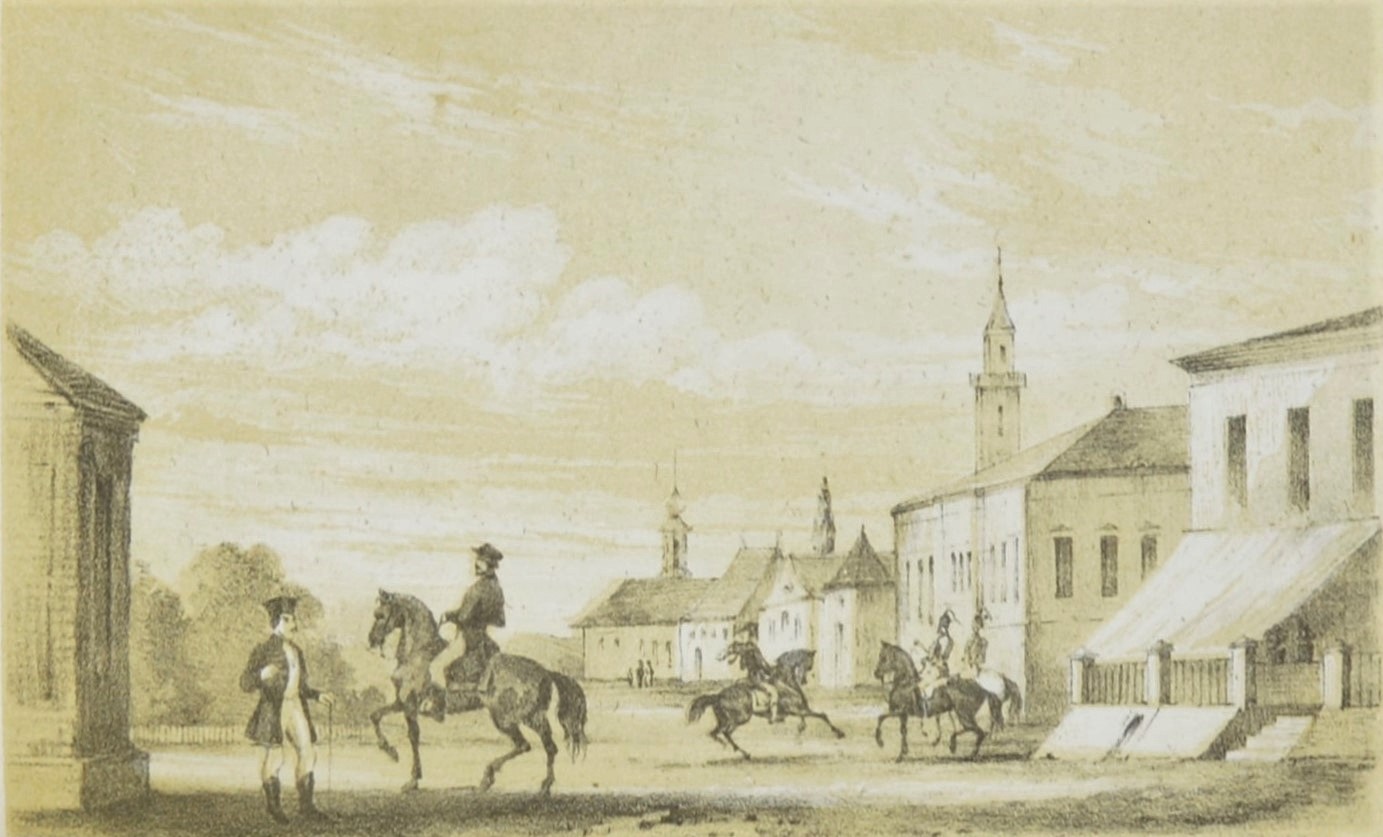 |
| "City and Costume of the Gentry" from Charles Loring Brace's Hungary in 1851; with an Experience of the Austrian Police (New York, 1852) |
William Stiles' two-volume Austria in 1848-49: Being a History of the Late Political Movements in Vienna, Milan, Venice and Prague; with Details of the Campaigns of Lombardy and Novara; a Full Account of the Revolution in Hungary; and Historical Sketches of the Austrian Government and the Provinces of the Empire is a comprehensive history of the revolutions in the Austrian Empire from the US Chargé d’affaires to Vienna, an eyewitness to many of the events. Hungary and Its Revolutions from the Earliest Period to the Nineteenth Century with a Memoir of Louis Kossuth devotes two-thirds of its 545 pages to Kossuth and the revolution of 1848. If midshipmen wished to remind themselves of the speech Kossuth gave in the Maryland senate chamber, or wanted to read some of his many other speeches, they could consult Select Speeches of Kossuth compiled by Francis W. Newman. For General Artúr Görgei’s perspective on events, they could consult his two-volume My Life and Acts in Hungary in the Years 1848 and 1849. All of these volumes are available in Special Collections & Archives.
According to Charles Loring Brace, "If eloquence is to be judged from its effects, there has been no orator like Kossuth since Demosthenes." The contributor to the North American Review would agree: "The triumph of his eloquence in England and the United States form a memorable epoch in the history of both....he appears before immense assemblies, and seems to move their hearts at will, by the strange enchantment of his discourse." Yet, despite his popular appeal, neither the British nor American governments were interested in supporting the cause of Hungarian independence. Kossuth remained in exile for the rest of his life, residing in England for eight years and then moving to Italy, where he died in 1894 at the age of 91.
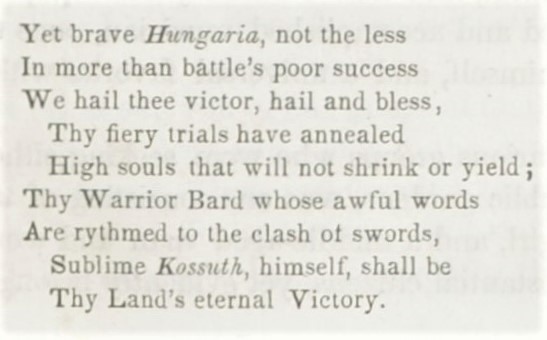 |
| Last stanza of Burleigh's "Kossuth" |
Sources:
Brace, Charles Loring. Hungary in 1851; with an Experience of the Austrian Police. New York: Charles Scribner, 1852. DB943.B79 1852
Kossuth, Lajos. Select Speeches of Kossuth. Edited by Francis W. Newman. London: Trübner & Co., 1853. DB937.5.N55 1853
"Movements of Kossuth: Arrival of Kossuth at Annapolis; the Maryland legislature and Kossuth, &c.--the Southern mail." New-York Daily Tribune (1842-1866), Jan. 13, 1852. https://www.proquest.com/historical-newspapers/movements-kossuth/docview/570177376/se-2?accountid=14748 (accessed March 18, 2021).
Pulszky, Francis and Theresa Pulszky. White, Red, Black: Sketches of Society in the United States during the Visit of Their Guest. 3 vols. London: Trübner and Co., 1853. http://www.google.it.ao/books?id=aXEo84j72_QC&pg=PA1#v=onepage&q&f=false
Review of Austria in 1848-49: Being a History of the Late Political Movements in Vienna, Milan, Venice and Prague; with Details of the Campaigns of Lombardy and Novara; a Full Account of the Revolution in Hungary; and Historical Sketches of the Austrian Government and the Provinces of the Empire by William H. Stiles. North American Review 75 (October 1852): 424-472.
S., E.O. Hungary and Its Revolutions from the Earliest Period to the Nineteenth Century. With a Memoir of Louis Kossuth. London: Henry G. Bohn, 1854. DB937.S4 1854
Spencer, Donald S. Louis Kossuth and Young America: A Study of Sectionalism and Foreign Policy, 1848-1852. Columbia and London: University of Missouri Press, 1977. DB937.3.S66
Stiles, William H. Austria in 1848-49: Being a History of the Late Political Movements in Vienna, Milan, Venice, and Prague, with Details of the Campaigns of Lombardy and Novarra; a Full Account of the Revolution in Hungary; and Historical Sketches of the Austrian Government and the Provinces of the Empire. 2 vols. New York: Harper & Brothers, Publishers, 1852. DB83.S85 1852
United States Naval Academy. Record Group 405.2.2, Office of the Superintendent: Directives. Entry 46, Orders of the Superintendent 1851-1865.
United States Naval Academy. Record Group 405.3.1, Office of the Commandant: General Records. Entry 151d, Watch Logs and Reports, 1845-2016.
Webster, Daniel. The Works of Daniel Webster. 4th ed. 6 vols. Boston: Little, Brown and Company, 1853 E337.8.W376 1853
Category: