
The Turtle turns 250
POSTED ON: Thursday, September 10, 2026 12:00 AM by Jennifer Bryan
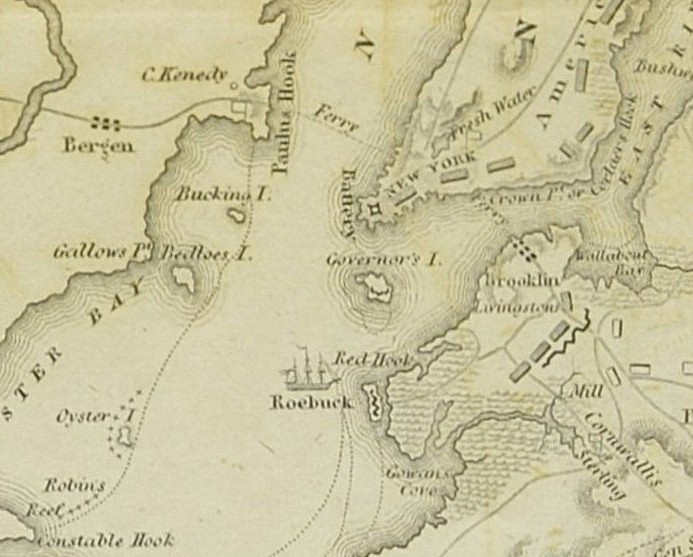
Shortly before midnight on September 6, 1776, Sergeant Ezra Lee of Samuel Parsons's brigade of Connecticut troops squeezed himself into the Turtle, the invention of Connecticut farmer and Yale graduate David Bushnell (1740-1826), and set off into New York Harbor towards the British fleet. The first submarine designed for offensive warfare, Turtle’s target was HMS Eagle, the 64-gun flagship of Admiral Richard Lord Howe. Carrying a mine above the rudder, Turtle would enable Lee to stealthily approach the flagship from below, attach the mine, and move out of range before the mine detonated. British forces had arrived in New York on June 29 and had defeated the American army at the Battle of Long Island on August 27. Rather than immediately pursue the Americans, who had retreated to defensive positions on Brooklyn Heights, Major General Sir William Howe, the admiral’s younger brother, prepared to lay siege to their works. General George Washington took advantage of this pause to evacuate his forces to Manhattan on the night of August 29. Turtle had a limited time to make an attempt on the flagship, since the American army was preparing to withdraw from New York City.
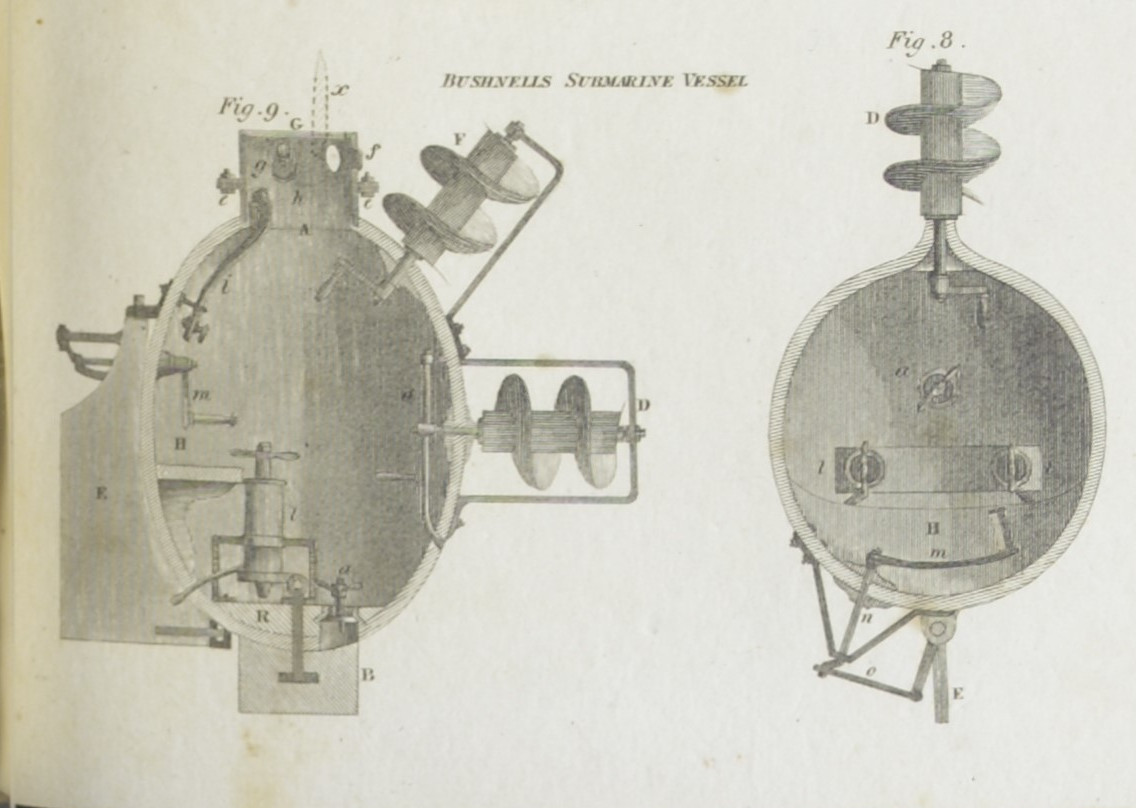
Lee was the most skilled of three substitutes that Bushnell had quickly trained in the operation of his invention after Bushnell’s brother, who had mastered maneuvering Turtle in a series of trials, had fallen ill. Turtle was an oaken vessel, its shape resembling two upper tortoise shells of equal size, joined together; the place of entrance … being represented by the opening made by the swell of the shells, at the head of the animal.
The brass hatch, which resembled a hat with its crown and brim,
contained several small glass windows for admitting light and enabling the operator to see where he was going. Two pipes in the crown allowed for air circulation. When submerged, the pipes closed automatically. To descend, the operator depressed a brass valve which allowed water to enter through an opening in the bottom of the vessel. To ascend, a brass pump at each hand forced water out of the bottom. While submerged, the operator could move Turtle up and down, forward and backward, by means of propellers, one at the top of the vessel and the other at the front. A tiller inside the submarine was attached through the hull to the rudder, which also could be used to row forward. Turtle was equipped with a compass, a water-gauge indicating the submarine’s depth, and a line and lead to sound the depth when necessary. Bushnell used foxfire to illuminate the compass and water-gauge.
In describing his invention, Bushnell would later write, Particular attention was given to bring every part, necessary for performing the operations, both within and without the vessel, before the operator, and as conveniently as could be devised, so that everything might be found in the dark … and nothing required the operator to turn to the right hand, or to the left, to perform any thing [sic] necessary.
A powder magazine,
a mine, made of two pieces of hollowed out oak containing 150 pounds of gunpowder was attached to Turtle by a screw turned by the operator. Forward of the hatch, in the brim,
was a mechanism for attaching a wood screw to the hull of the enemy vessel. A strong rope extended from the mine to the wood screw. Once the wood screw had penetrated the hull, the operator would release the mine, which contained a clockwork that was set to trigger a flintlock mechanism that would detonate the mine.
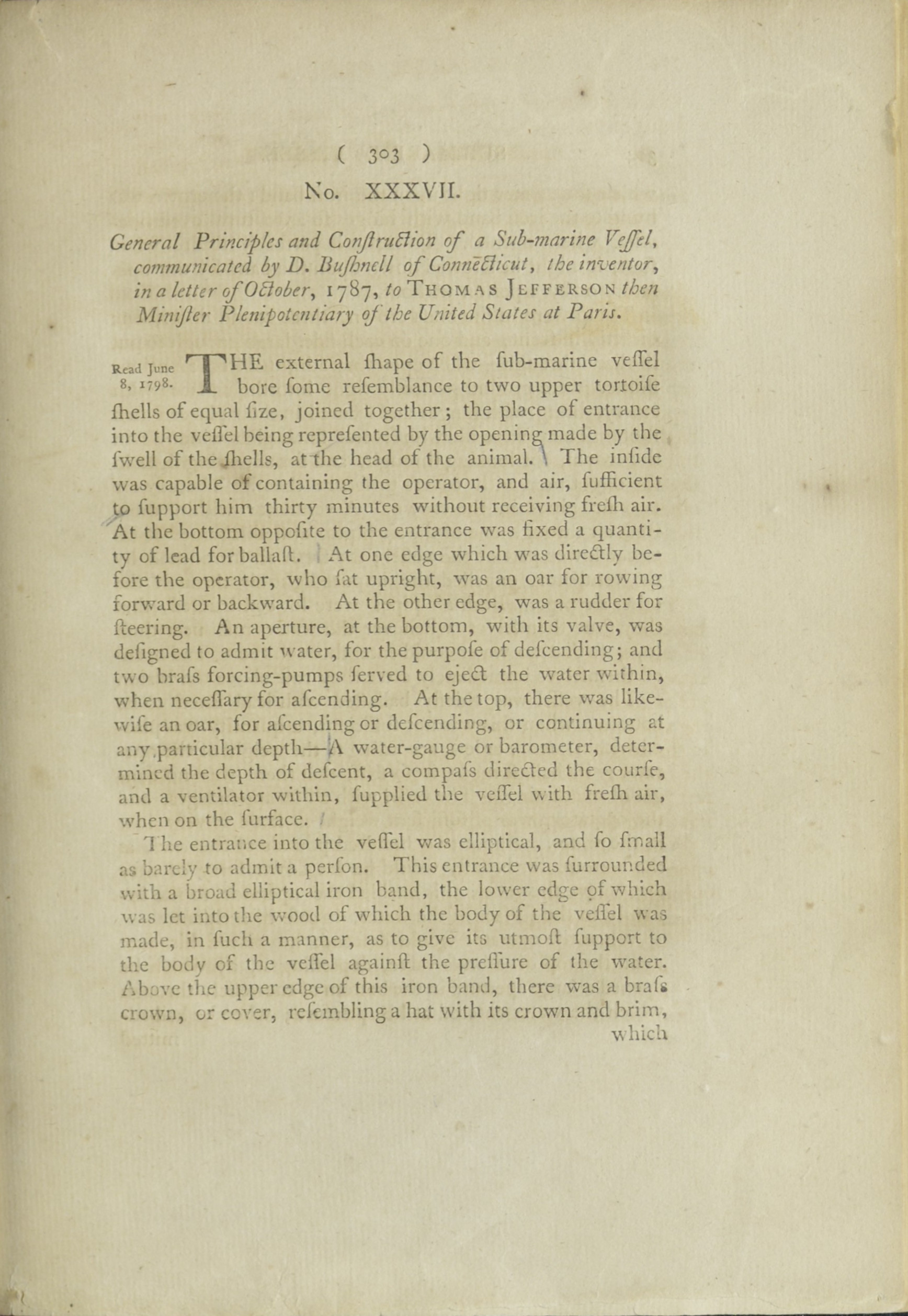 Bushnell’s description of his invention from the Transactions of the American Philosophical Society, 1799.
On the night of the attack, Lee had to maneuver Turtle through the current in New York Harbor to prevent the submarine from drifting past HMS Eagle, anchored off Bedloe’s Island. By the time he was able to move into position at the flagship’s stern and submerge, it was nearly dawn. Getting to keel depth required keeping in contact with Eagle, since there was no way to see the ship once under water. Lee’s attempt to attach the wood screw to the hull failed. Turtle could stay submerged for no more than a half hour. Knowing he was running out of air, Lee tried a second time to attach the wood screw without success. He lost contact with the ship, and Turtle bobbed to the surface. Since there was now little time before sunrise, Lee could not chance another attempt. As he passed Governor’s Island on his return to Manhattan, British troops stationed there saw Turtle, and several men began rowing a barge toward the submarine. When they were about 50 yards away, Lee released the mine, which put the clockwork in motion. When the men in the barge saw the mine float to the surface, fearing what it might be, they rowed back to the island. After the magazine had been cast off one hour, the time the internal apparatus was set to run, it blew up with great violence.
Before Turtle could try again to destroy HMS Eagle, the American army evacuated New York City. The submarine was hoisted aboard a sloop and taken upriver to Fort Washington. Three Royal Navy vessels sailed up the Hudson and anchored opposite Bloomingdale, just below the fort. In an attempt to destroy one of the ships, Bushnell put Turtle in operation once more, again with Sergeant Lee as operator, and once again the attempt failed. A third try with a different operator also failed. On October 9, the British warships sailed up the Hudson from their anchorage, chasing the American’s little fleet and sinking the sloop carrying Turtle. Although Bushnell was able to recover the submarine, he never had another opportunity to put it into action.
In a September 1785 reply to an inquiry from Thomas Jefferson, George Washington wrote, Bushnel [sic] is a Man of great Mechanical powers — fertile of invention — and a master in execution—He came to me in 1776. ... Although I wanted faith myself, I furnished him with money, and other aids to carry it [his plan] into execution. ... I then thought, and still think, it was an effort of genius.
The US Navy has named two vessels, both submarine tenders, after the Turtle’s inventor. The first - USS Bushnell (AS-2), commissioned in November, 1915 - was redesignated AG-32 on July 25, 1940, and renamed USS Sumner on August 23. The second USS Bushnell (AS-15) was commissioned in 1943. Several books on Bushnell and his Turtle can be found in Special Collections & Archives in the Dr. Thomas O. Paine Collection of Submarine Books and the Chester L. Somers Submarine Collection.
About the author: Jennifer A. Bryan. Ph.D., is the Head of Special Collections & Archives/Archivist, Nimitz Library, United States Naval Academy
Sources:
Brewster, David. The Edinburgh Encyclopaedia. Philadelphia, 1832.
Bushnell I (AS-2); Bushnell II (AS-15), Dictionary of American Naval Fighting Ships, Washington, D.C.: Naval History and Heritage Command, 2006.
Bushnell, D. General Principles and Construction of a Sub-Marine Vessel, Communicated by D. Bushnell of Connecticut, the Inventor, in a Letter of October, 1787, to Thomas Jefferson Then Minister Plenipotentiary of the United States at Paris.
Transactions of the American Philosophical Society 4 (1799): 303-12. Unattributed quotes are from this source.
George Washington to Thomas Jefferson, 26 September 1785,
Founders Online, National Archives, https://founders.archives.gov/documents/Washington/04-03-02-0251. [Original source: The Papers of George Washington, Confederation Series, vol. 3, 19 May 1785-31 March 1786, ed. W. W. Abbot. Charlottesville: University Press of Virginia, 1994, pp. 279-283.]
Manstan, Roy R. and Frese, Frederic J. Turtle: David Bushnell’s Revolutionary Vessel. Yardley, PA: Westholme Publishing, 2010.
Wagner, Frederick. Submarine Fighter of the American Revolution: The Story of David Bushnell. New York: Dodd, Mead & Company, 1963.
Category: