Reading
These notes and
closely review
Unit 5
Section 4.1.
Graph Sermon
In reviewing the homework, I gave a little sermon on the
importance of graphs. Basically, many, many problems in
computing boil down to problems about graphs. This a great
thing, since we have so many existing algorithms for graphs and
graph problems and so many theoretical results about graphs.
These are all tools that we can bring to bear on a problem once
we are able to cast it as being about graphs.
Undirected Graphs and Trees
Til now we have mostly been interested in
directed
graphs, i.e. graphs where the edges have a direction (visually,
an arrow). Now we will consider
undirected graphs,
where edges are directionless connections between vertices.
Our first question is going to be this: what do we mean by a
"tree" in a directionless graph? Without directed edges, the
concept of parent, which was the basis of our
understanding of tree in the world of directed graphs, doesn't make sense.
Our definition relies on the concept of a connected
graph, and of a cycle.
We say graph $G$ is connected if for any two
vertices $u$ and $v$ there is a path in $G$ from $u$ to $v$.
If $G$ is a graph with edge set $E$ we
say that $v_0,v_1,\ldots,v_{n-1}$ is
a cycle in $G$ if for each $i\in\{1,\ldots,n-1\}$
we have $(v_{i-1},v_i)\in E$ and $(v_{n-1},v_0)\in E$.
We call undirected graph $G$ a tree if it is connected and has no cycles.
There is an equivalent characterization of trees as graphs in
which for every pair of vertices $u,v$ there is a unique path
from $u$ to $v$.
Undirected graph $G$ is a tree if and only if for any pair
of vertices $u,v$ there is a unique path
from $u$ to $v$.
Suppose $G$ is a tree. Let $u$ and $v$ be vertices in $G$,
then there is at least one path from $u$ to $v$ since $G$ is
connected (because it is a tree). If there were also a
different path connecting $u$ to $v$ then there would be a
cycle. [Note: we really ought to prove this assertion, but I
guess it's obvious enough to you that it is true, that
proving it wouldn't be helpful.]
Thus the path is unique.
Suppose that for any pair
of vertices $u,v$ there is a unique path
from $u$ to $v$. In this case, $G$ is obviously
connected. It also has no cycles, since a cycle would
give us a pair of vertices connected by two different
paths. Since $G$ is connected and has no cycles, it is a
tree.
Weighted graphs and Spanning Trees
Note: we often describe a graph by the ordered pair $(V,E)$
where $V$ is the set of vertices of $G$, and $E\subseteq V\times V$
is the set of its edges.
$G'=(V',E')$ is a subgraph of graph $G=(V,E)$
if $V' \subseteq V$ and $E' \subseteq E$.
Tree $T=(V',E')$ is a spanning tree of connected graph $G
= (V,E)$ if $T$ is a subgraph of $G$ and $V' = V$.
$G = (V,E,w)$ is a weighted graph if $(V,E)$ is an
undirected graph and $w$ is a function that maps and edge to a
weight. Weights may come from the reals, integers, positive
integers, etc.
Tree $T$ is a minimum spanning tree of
connected weighted graph $G$ if $T$ is spanning tree and the sum of the weights
of the edges in $T$ is the minimum amongst all spanning trees.
Minimum Spanning Tree
Here is Prim's Algorithm for computing a minimum spanning tree
of a graph from starting vertex $r$.
	Algorithm: Prim's MST
	Input : G, a connected, weighted, undirected graph with n vertices and e edges
        r, a vertex in G
	Output: T a minimum weight spanning tree for G (reprented by a "parent" array)

	0. create P, the "parent" array, with each entry initialized to nil (means "unknown")
	P[r] = -1 ← means r is root, NOTE: only r is in the current MST

	1. select edge (u,v) where P[v] = nil (i.e. parent "unknown") and P[u] ≠ nil,
	such that (u,v) has minimum weight amongst all such edges
	IF no such edge exists, return P

	2. P[v] = u  ← i.e. add v to the current MST by connecting it to u

	3. goto Step 1
Proof that Prim's algorithm gives a minimum spanning tree
First we have to prove that the greedy algorithm is always part
of some optimum solution.
If $T'$ is a subtree of a minimum spanning tree
for $G$, then there is a complete minimum spanning tree for
$G$, call it $T$, that contains $T'$ and contains the edge $(u,v)$
that is the minimum weight edge from a vertex in $T'$ to a
vertex not in $T'$.
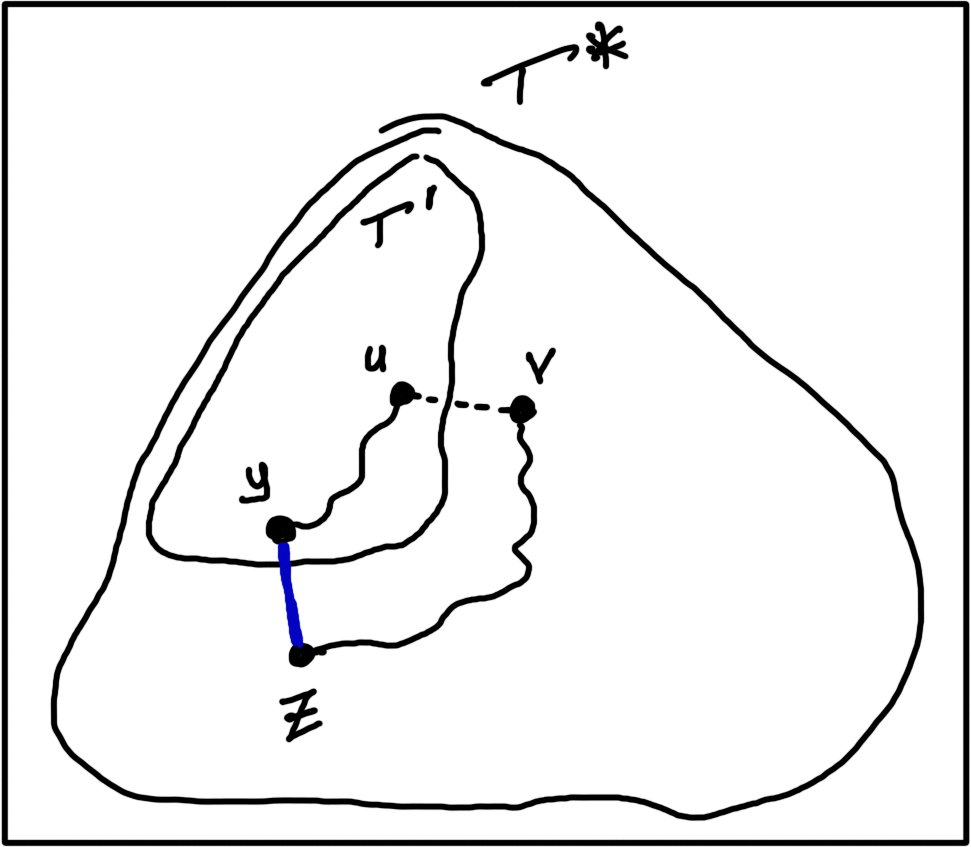
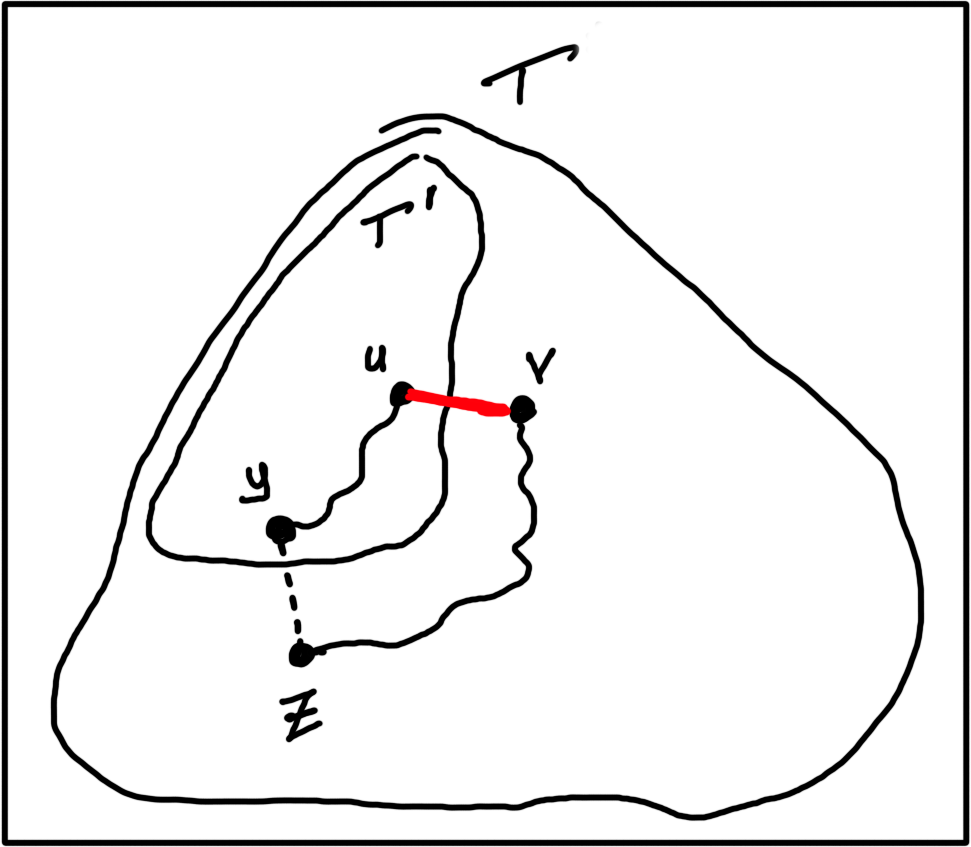
Let $T^*$ be a spanning tree that contains $T'$ but does not contain the
edge $(u,v)$. We will show how to "repair" it to create a
tree that still contains $T'$, but also contains $(u,v)$,
without increasing the total weight of the resulting tree.
The unique path from $u$ to $v$ in
$T^*$ leaves $T'$ along some edge $(y,z)$, i.e. $y$ is in
$T'$, but $z$ is not. If we remove $(y,z)$ from the
spanning tree we have two
disconnected trees, the one containing $u$ and the one
containing $v$. If we then add the edge $(u,v)$ to the
spanning tree, we
reconnect the two trees, resulting in a new spanning
tree, call it $T$. Since the weight of $(u,v)$ $\le$ the
weight of $(y,z)$, the overall weight of $T$ is $\le$ the
overall weight of $T^*$.
Essentially this proof is an algorithm that transforms tree
$T^*$ from a minimum weight spanning tree that doesn't use
edge $(u,v)$ to a minimum weight spanning tree that uses edge
$(u,v)$. If we were to write this out formally we would say:
Input: Graph $G$, sub-minimum-spanning tree $T'$, complete minimum spanning
tree $T^*$ that extends $T'$ to include all the vertices, and
edge $(u,v)$ of minimum weight where $u\in T'$ and $v \notin T'$
such that $(u,v) \notin T^*$.
Output: complete minimum spanning tree $T$ that extends $T'$ and
includes the edge $(u,v)$
 |
→ |
 |
The second thing we have to prove is that finding an optimum solution to
the smaller subproblem yields an optimum solution to the
original problem.
At first this is a bit confusing, because the way we've
phrased Prim's algorithm, it's not clear that we have a
"smaller problem of the same kind" to solve. So let's imagine
specifying the problem Prim's algorithm is solving in a
slightly different way:
    Problem: Minimum Weighted Spanning Tree (containing proscribed subtree)
    Given: a connected Graph G (V is the set of vertices, E the set of edges)
    a subtree T' of G spanning the vertex set R, which is a subset of V
    Find : a spanning tree T of the graph G that contains T' as a subtree
    and has minimum weight over all such spanning trees.
Hopefully you see that Prim's algorithm can be viewed as
solving a sequence of such problems, where $|V-R|$ gets
smaller at each step. Now what we have to prove is trivial,
because a solution to the "smaller sub-problem"
is a
solution to the original problem, and therefore finding an
optimal solution to the smaller subproblem is indeed the right
thing to do.