Reading
These notes and
Unit 6 sections 6 and 7.
Problems with the obvious "reduction" of CIRCUIT-SAT to SAT
If we have a Problem Y in NP and we would like to prove that it
is NP-COMPLETE, all we have to do is poly time reduce a known
NP-COMPLETE problem to Y. That was our conclusion from last
class. An obvious first thing to try is to reduce CIRCUIT-SAT
to "SAT", which is this: given a boolean formula, is there an
assignment of values to variables that makes the formula true?
There is a simple algorithm for doing this conversion. First,
we will assume the circuit has only ands, ors and nots, and
that the ands/ors have eatly two inputs, and the nots have
exactly one input. If
the curcuit doesn't satisfy these properties, it can be
modified so that it does, and the new circuit is at most a
constant factor larger than the original.
Algorithm: mkf(C,u)
Inputs: Circuit C (as described above) and node u in the circuit
Output: Boolean formula F equivalent to C
---------------------------------------
if node u is variable xi, return formula xi
if u is an "and" gate
   let v and w be the nodes that feed into u
   return formula ( mkf(G,v) ) ∧ ( mkf(w) )
else if u is an "or" gate
   let v and w be the nodes that feed into u
   return formula ( mkf(G,v) ) ∨ ( mkf(w) )
else
   let v be the node that feeds into u
   return formula ¬( mkf(F,v) )
It's easy to prove (with induction!) that for circuit C with
output node u, the formula mkf(C,u) is equivalent to the circuit,
meaning that any assignment of values to the xi's that satisfies
the circuit satisfies the formula and vice versa. Here's an
example:
      Circuit C
                 .___
      x1---NOT---|and\___    mkf(C,"the and gate") = (¬(x1)) ∧ (x2)
      x2---------|___/
Unfortunately, this does not give us a polynomial time
reduction. We looked in class at an example of a family of inputs
for which this algorithm produces exponentially larger formulas
than circuits.
      C1 = x1,

      Cn = Cn-1--------------OR---
               \____.---.    /
           xn-------|xor|---'
                    `---'
The size of this circuit in number of edges is 4*(n-1) and in
vertices is n + 2*(n-1). Either way, it's linear in $n$.
Algorithm mkf produces the formula
$$F_1 = x_1,\ \ \ F_n = F_{n-1} \vee \left(F_{n-1} \oplus x_n\right)$$
... which has more than $2^{n-1}$ operators.
3CNF-SAT
A propositional (boolean) formula $F$ is in
Conjunctive Normal Form if it has the following form:
$
F = C_1 \wedge C_2 \wedge \cdots \wedge C_n
$
where each $C_i$ is what's called a
clause.
A clause is of the form
$
C_i = l_1 \vee l_2 \vee \cdots \vee c_k
$
where each $l_j$ is what's called a literal.
A literal is simply a boolean variable, or its negation - i.e.
$x_i$ or $\neg x_i$. Finially, a "3CNF" formula is a
formula in CNF, with the added restriction that each clause has
at most three literals.
So, for example the following is a 3CNF
formula:
$
(a \vee \neg b \vee \neg c)
\wedge
(\neg a \vee b \vee c)
\wedge
(\neg a \vee \neg c)
$
Of course, the 3CNF-SAT problem is simply this: given a
formula in 3CNF, is there an assignment of values to the
formula's variables for which the formula evaluates to true?
Formulas in CNF are really nice to work with, because they
have such a simple, regular structure. So most logic
applications require their input to be in CNF. 3CNF is even
more restricted. That restriction is really nice for analysis
purposes, as we'll see in the following.
3CNF-SAT is NP-Complete
In the below, we'll give a polynomial time reduction of
CIRCUIT-SAT to 3CNF-SAT. First, we observe that we can take a
circuit and expand it slightly (i.e. polynomially)
to produce an equivalent circuit containing only AND, OR and NOT
gates, and in which the AND and OR gates have only two inputs
each. We discussed this in class. Now consider the following
conversion of gate to 3CNF formula:
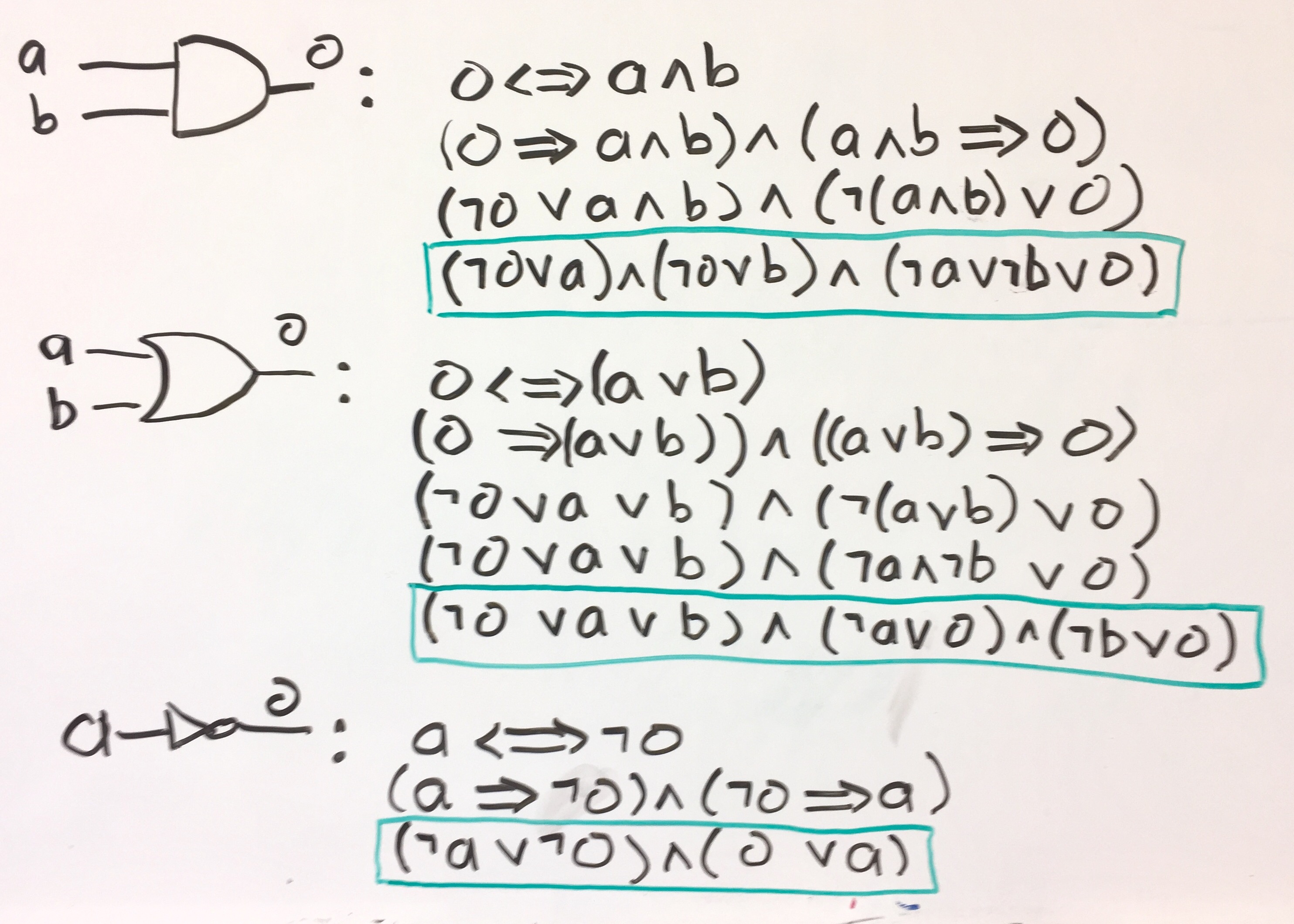
With these rules in place, we can convert a circuit to
its formula equivalent. Here's what we do:
-
number the gates $g_1,\ldots,g_k$ where the numbering is a
topological sort. Note that this means that the last gate
is the output for the whole circuit.
-
for each gate $g_i$ create a variable $o_i$, so now we
have the original variables $x_1,\ldots,x_n$ plus the
new $o_i$ variables, one per gate.
-
for each gate $g_i$ create formula $f_i$ using the above
rules
-
return formula $f_1 \wedge f_2 \wedge \cdots \wedge f_k
\wedge o_k$
The original circuit is satisfiable if and only if the
formula is satisfiable (the proof is the same as the proof we
gave for the conversion to SAT) and the process is clearly
polynomial time.
The idea behind the translation is that each $f_i$ encodes the
assertion that the gate functions properly, for example that an
AND-gate really outputs the "and" of its inputs. So the formula
specifies that "gate 1 operates correctly, and cate 2 operates
correctly, .... and gate $k$ operates correctly, and gate $k$
outputs TRUE".
Example:
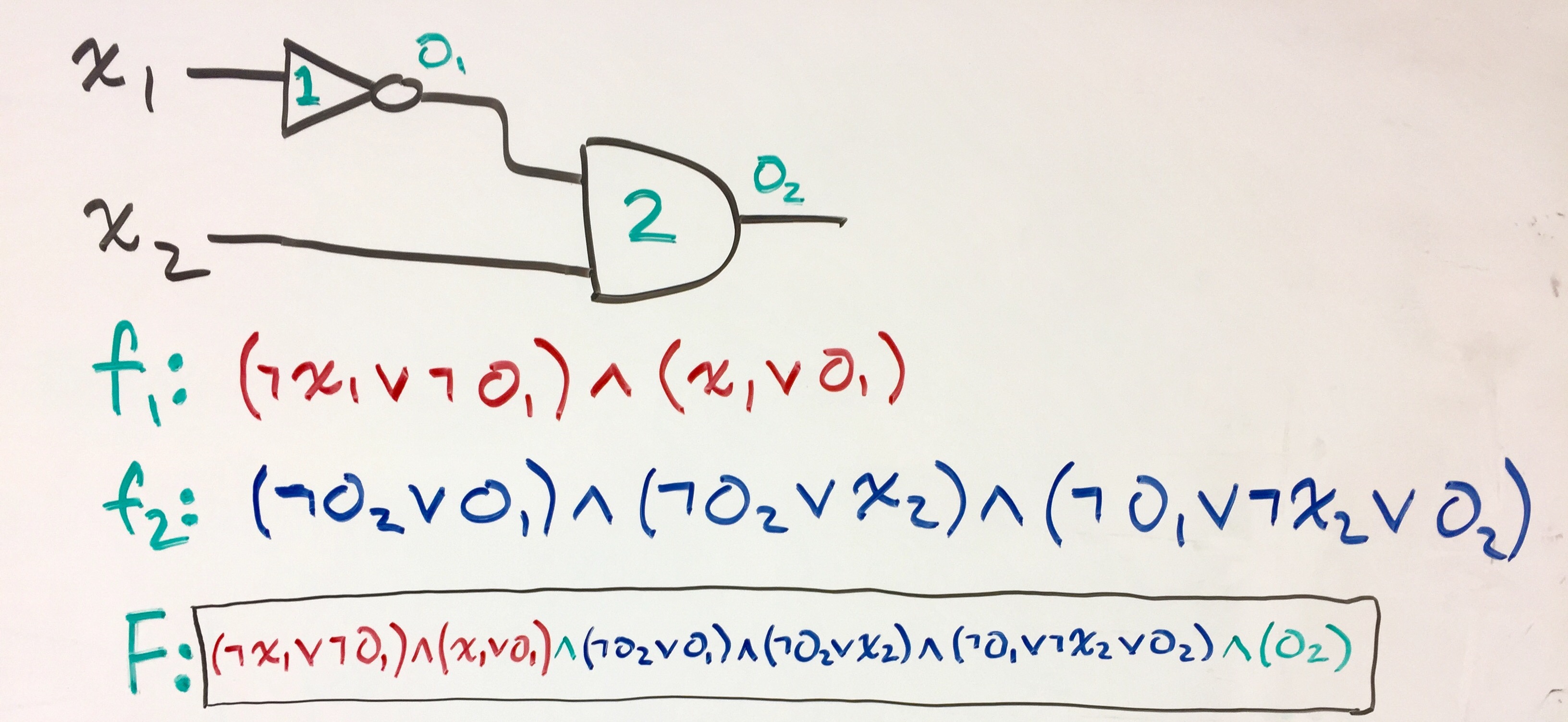
So, now that we have a polynomial time reduction from
CIRCUIT-SAT to 3CNF-SAT, we've proved the following:
Theorem: 3CNF-SAT is NP-Complete.
The INDEPENDENT-SET Problem
So far, all the problems that we've proven to be NP-Complete
are closely-related problems ... all three are really about
logic. Now let's consider a very different problem: a graph
problem. The INDEPENDENT-SET Problem is this: Given unweighted,
undirected graph $G$, and positive integer $k$, is there an
independent set in $G$ of size $k$? Note: an independent
set is a set of vertices from $G$ that have no edges
between them.
INDEPENDENT-SET is NP-Complete
Theorem: INDEPENDENT-SET is NP-Complete.
We prove this by giving a polynomial time reduction of
3CNF-SAT to INDEPENDENT-SET. So, we're given a 3CNF formula.
Let $k$ be the number of clauses in the formua.
We create a graph that has $k$ "clusters" of vertices, one
cluster for each clause. A cluster for clause
$C_i = (l_{i,1} \vee l_{i,2} \vee l_{i,3})$ consists of
three vertices, each labeled with one of the three literals
from the clause. If the clause only has 2 (or 1) literal, the
cluster will only have 2 (or 1) vertices. Each vertex in a
cluster is connected by an edge to every other vertex in the
cluster. Also, a vertex in a given cluster labeled with
literal $l$ has an edge to every vertex in the other clusters
labeled $\neg l$. The claim is that this graph has an
independent set of size $k$ if and only if the original
formula is satisfiable.
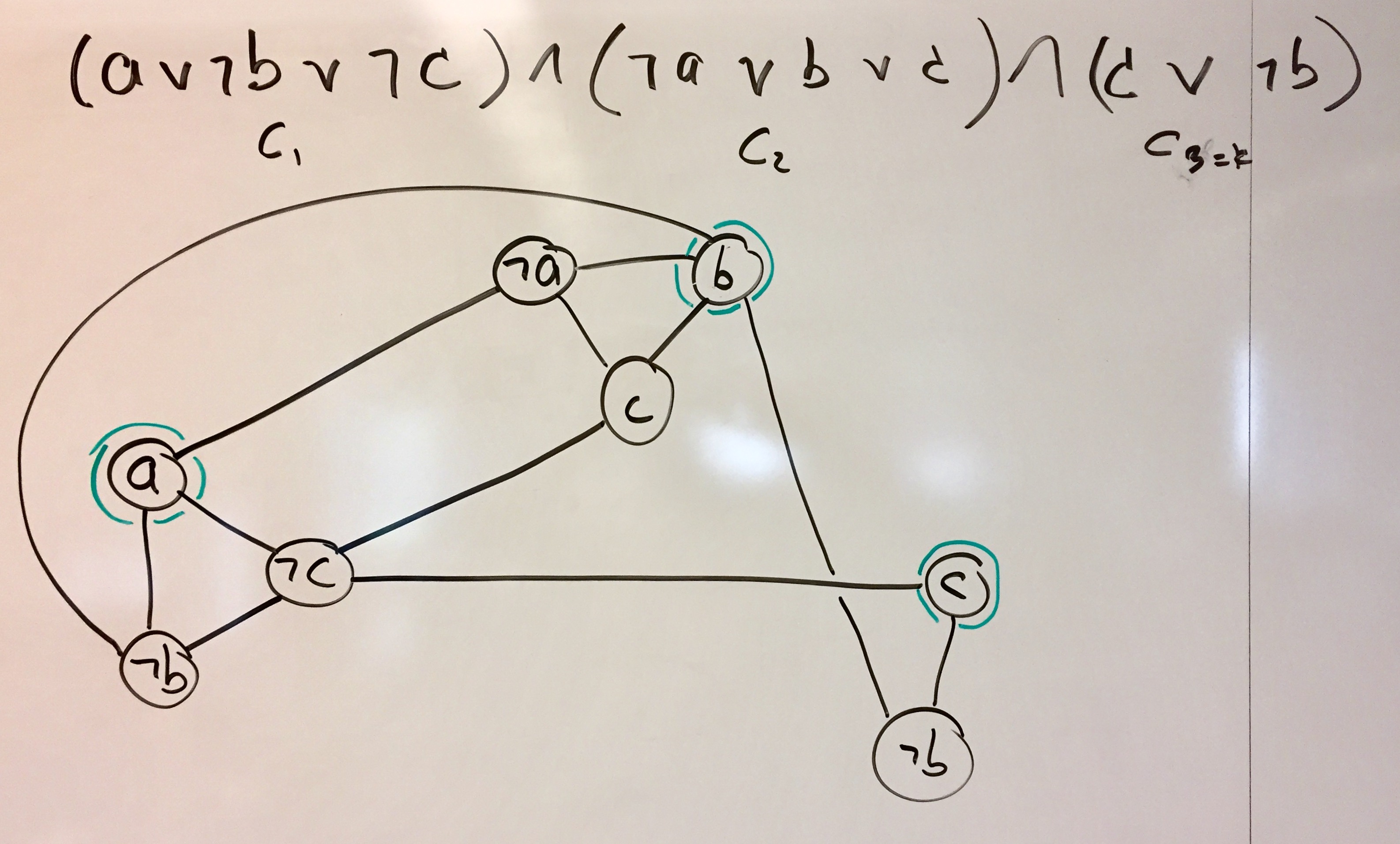
Example: This example shows the graph derived from
a 3CNF formula. The resulting INDEPENDENT-SET problem has
$k=3$, since the formula has three clauses. In green, the
vertices comprising an independent set of size 3 are circles.
Notice that they correspond to a satisfying assignment of
values to variables in formula.
NP-Complete Problems Surround Us!
For better or for worse, the world is full of NP-Complete
problems. See
Wikipedia's
list of NP-Complete Problems.
This includes problems like
HAM-CYCLE, O/1-KNAPSACK, SIMPLE-KNAPSACK, HITTING-SET,
PARTITION, and many, many more.