Group members rate their peers within the group using the
following rubric. (Note: Rating of team members should reflect each individual's level of participation, effort, and sense of responsibility, NOT academic ability! Specific ratings of team members will remain confidential.)
| Abbrv |
Rating |
Description |
| E |
Excellent |
Consistently went above and beyond; tutored teammates, routinely did far more than his/her assigned team responsibilities. |
| VG |
Very Good |
Always did what he/she was supposed to do, very well prepared and cooperative. |
| G |
Good |
Mostly did what he/she was supposed to do, acceptably prepared and cooperative. |
| S |
Satisfactory |
More often than not did what he/she was supposed to do, minimally prepared and cooperative. |
| M |
Marginal |
Sometimes failed to show up or complete assignments, rarely prepared. |
| D |
Deficient |
Often failed to show up or complete assignments, rarely prepared. |
| U |
Unsatisfactory |
Consistently failed to show up or complete assignments, unprepared. |
The peer evaluations are used to compute a multiplier
for each group member. The project receives an overall grade of
X points without factoring in peer evaluations.
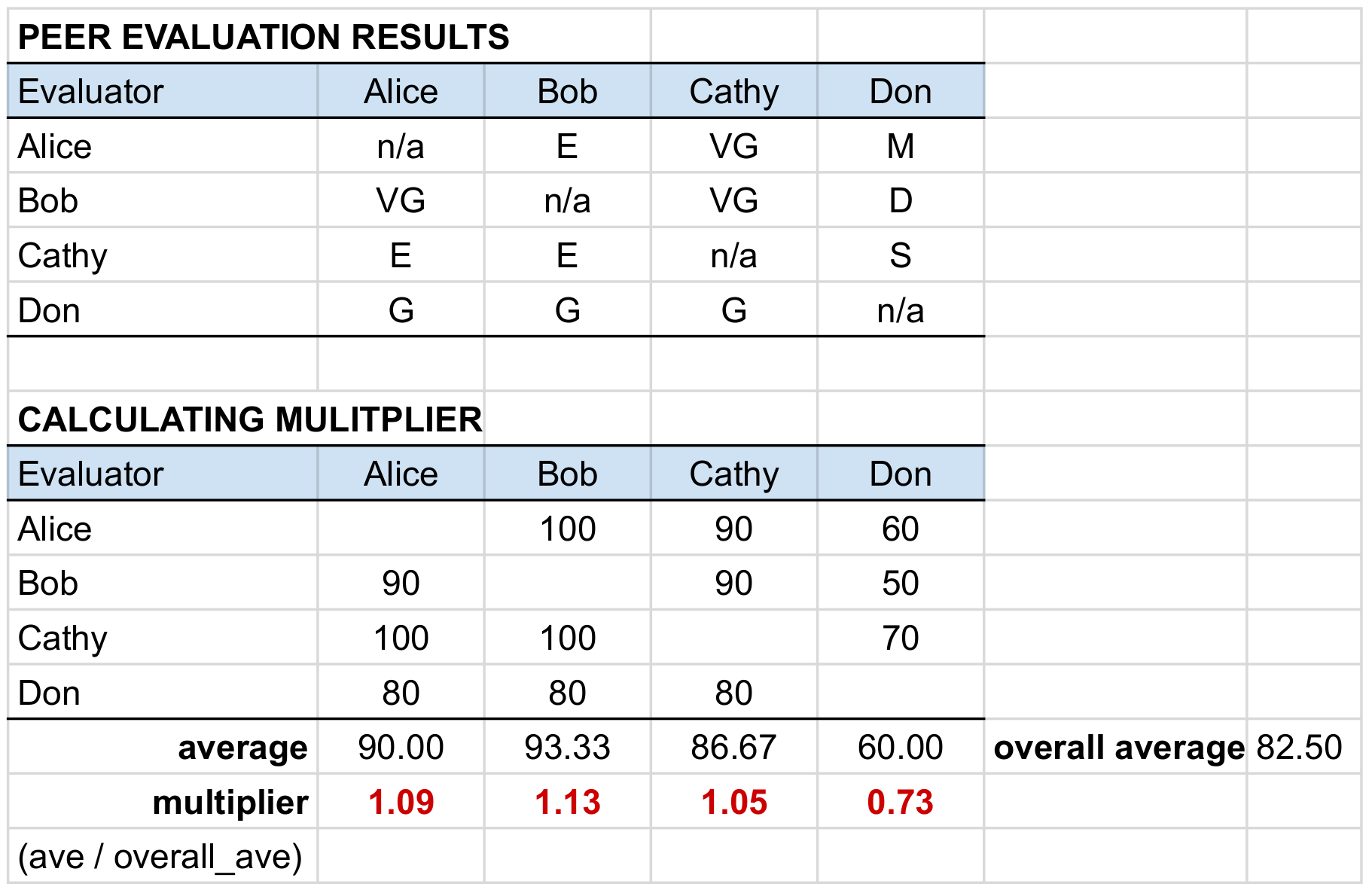
Group member $g$ with peer-eval multiplier $m_g$ receives as
their individual grade $X \cdot m_g$ points. The example below
illustrates how the peer-eval multipliers are computed.
| Rating-to-points |
|
Example of how multipliers are computed |
| Excellent | 100 |
| Very Good | 90 |
| Good | 80 |
| Satisfactory | 70 |
| Marginal | 60 |
| Deficient | 50 |
| Unsat | 40 |
|
|
|
Continuing with the example: if this group's project received an
overall grade of 88 points, then Alice would get 88*1.09 = 95.9
points, Bob would get
88*1.13=99.4 points,
Cathy would get 88*1.05 = 92.4 points and
Don would get 8*0.73 = 64.2 points.
Note:
A link to the google form for peer evaluations was sent to you
via e-mail.